

Loupe Factory can now write the storefront product description for an inventory item from the details already on its record: the product, type, shape, size, weight, and attributes your team entered for operations. Admins and managers review the AI draft, edit it, and save it on the item, with costs and internal pricing kept out by design.
Why product descriptions fall behind in operations businesses
In most manufacturing and wholesale teams, the inventory record is rich and the product listing is bare. The record says 7x5 mm, Oval, AAA, 1.25 carats, Heated, because operations needs exactly that. The listing that a buyer or shopper reads says almost nothing, because nobody in a 15-person operation owns product copywriting.
So descriptions get written three ways, all bad: retyped by hand for a few flagship items and skipped for the rest, pasted between spreadsheets and a website admin until the words drift out of date, or generated in a separate chatbot that has never seen the item and invents details to fill the gap.
The fix is not another tool to feed. The facts that make a good product description already live on the inventory record. Loupe Factory now turns them into the words a shopper actually reads.
How Loupe Factory writes an AI product description from an inventory record
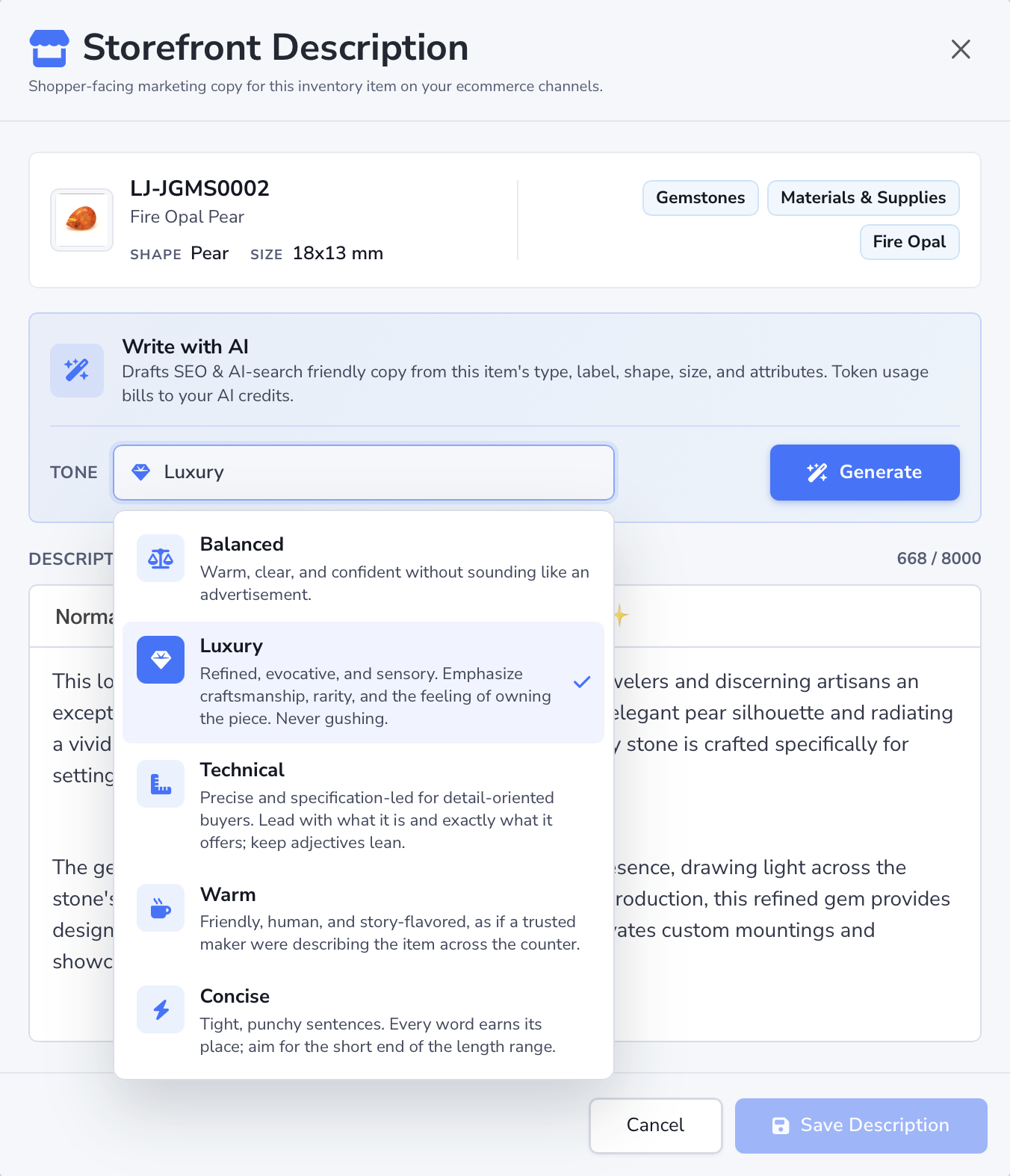
From any inventory table or item page, admins and managers open Storefront Description on an item. Pick one of five writing tones and click Generate. Review the draft in the formatting editor, then click Save Description to store it on the item record. The item's history notes who changed it and when.
Drafted from your facts
The AI reads the item's own details and your business's industry. It is told to use only what the record says, not to invent specifications.
Written in your voice
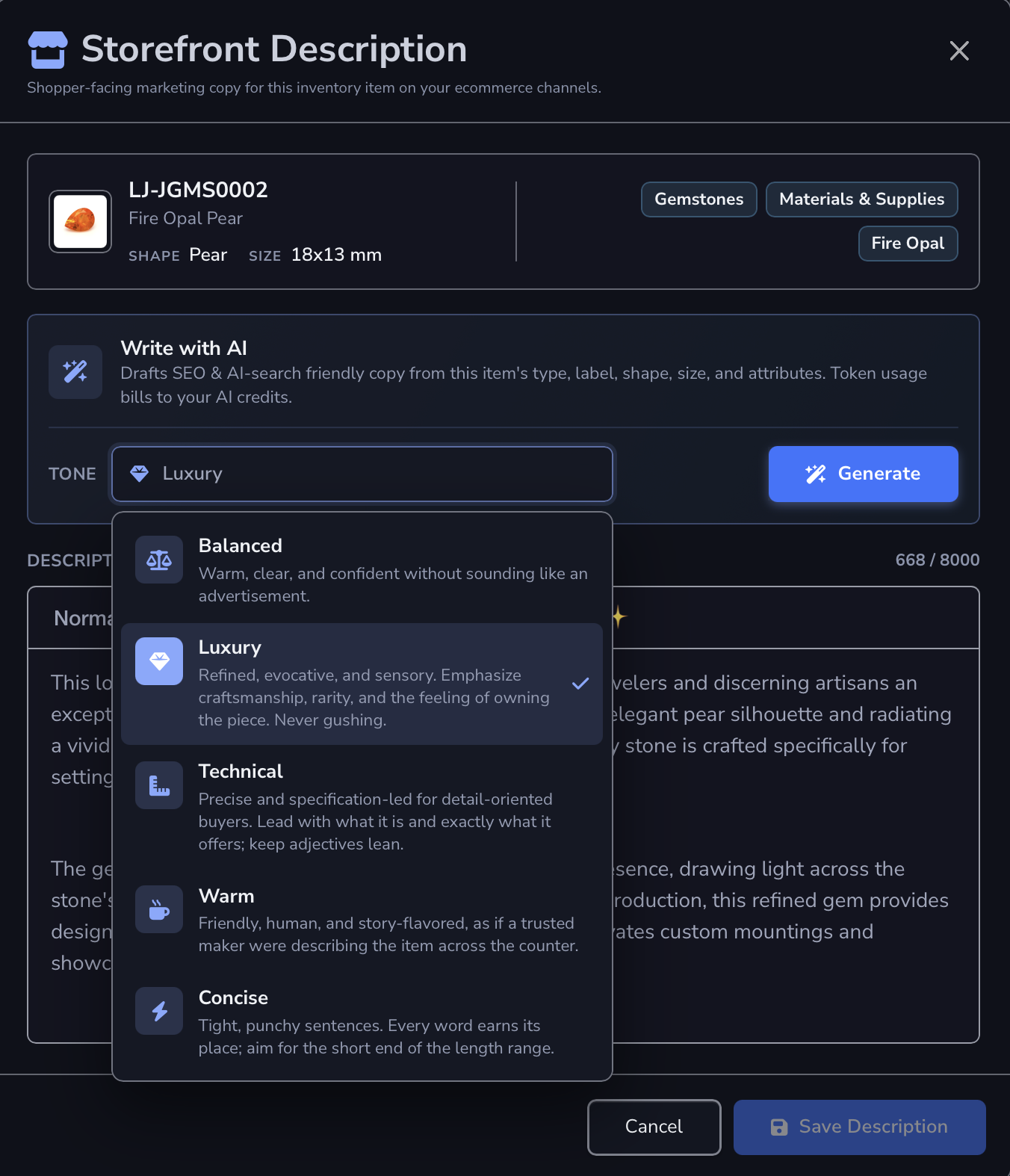
Choose Balanced, Luxury, Technical, Warm, or Concise. Generate again in a different tone until the copy sounds like your brand.
Reviewed before you save
Nothing is saved until you click Save Description. Cut a line, rewrite a phrase, add headings, lists, and links, or discard the draft entirely.
Each draft follows a deliberate structure: a short opening paragraph that plainly says what the item is and who it is for, a paragraph on why it is worth choosing, and a clean details list built from the record. If the item already has a description, generating again treats your current text as the starting point instead of writing from scratch.
Five writing tones, one honest source
The same gemstone parcel reads differently in a luxury boutique catalogue than it does in a B2B spec sheet. The tone selector changes the voice without changing the facts.
- Balanced Warm, clear, and confident. The default for most storefronts.
- Luxury Refined and sensory, leading with craftsmanship and rarity.
- Technical Specification-led for detail-oriented buyers, with lean adjectives.
- Warm Friendly and personal, like a trusted maker describing the piece across the counter.
- Concise Tight, punchy sentences for listings where space is short.
What the AI reads, and what it never touches
The draft is grounded in the shopper-safe parts of the record. Everything commercial or internal is excluded before the AI ever sees the item, so a pricing leak into public copy is not a mistake someone has to catch in review. It cannot happen.
| Read from the record | Kept out by design |
|---|---|
| Product name and storefront product label | Unit prices, currency, and rate details |
| Inventory type, finished type, and materials type, including the descriptions you wrote for them | Cost components and anything from internal pricing |
| Shape, size, color, and quality | Internal notes, which routinely carry supplier and pricing chatter |
| Weight with its unit, plus the item's custom attributes | Internal tag IDs and HS/HSN codes |
| Your business's industry | Stock levels and supplier information |
The AI is also instructed never to mention price, availability, discounts, or shipping in the copy itself, so the description stays evergreen while those numbers change elsewhere.
Written to be found by search engines and AI assistants
Buyers increasingly find products by asking a question, whether in a search bar or an AI assistant, and the listings that get surfaced are the ones that answer plainly. Every draft opens with a short, self-contained paragraph that says what the product is and who it is for, follows with the reason to choose it, and closes with a structured details list. That is the shape search engines and AI assistants extract answers from most easily.
No tool can honestly promise you a ranking. What Loupe Factory promises is narrower and more useful: descriptions built from accurate, structured facts, formatted the way modern search reads, on every item instead of only the flagship pieces.
A separate description tool vs descriptions inside your operations system
Most AI product description generators start with a blank prompt box or a catalog file you upload. That works until the details in the tool and the details in your inventory disagree. Loupe Factory starts from the record itself.
| Workflow | Separate description tool | Loupe Factory storefront descriptions |
|---|---|---|
| What the AI knows | Whatever you paste, upload, or re-export from your catalog. | The live inventory record: type, shape, size, weight, attributes, and your industry. |
| Where the work happens | Export data, generate elsewhere, copy the result back. | A modal on the inventory item, two clicks from the table your team already works in. |
| Pricing safety | Depends on what was in the file you uploaded. | Costs, internal pricing, and private notes are excluded before the AI sees the item. |
| Industry coverage | Often trained for one industry only. | Adapts to your business's industry, from gemstones to furniture to auto parts. |
| Where the result lives | A document or export you reconcile later. | Saved on the item record, with the change logged in the item's history. |
| Who can use it | Anyone with the tool's login. | Admins and managers, following your existing Loupe Factory roles. |
Built for every high-mix industry, not just jewelry
Jewelry and gemstone teams will feel at home here, because carats, cuts, clarity grades, and treatments are exactly the details the AI is reading. But the feature is industry-aware, not industry-locked. It writes from whatever your records hold.
- Jewelry and gemstones: a 1.25 carat oval sapphire's cut, color, clarity, and treatment become copy a boutique can publish as-is.
- Made-to-order furniture: dimensions, wood species, joinery, and finish attributes become the story of a piece worth commissioning.
- Specialty auto parts: fitment, material, and specification attributes become a listing a buyer can trust before ordering.
- Cosmetics and beauty: product types, sizes, and packaging attributes become clean, consistent copy across a large catalog.
- Job shops and wholesalers: any item with a well-kept record gets a description without anyone owning copywriting as a job.
Whatever the industry, the same rule holds: the better your inventory records, the better the words. Teams that already keep clean attributes get publish-ready copy on the first generate.
AI credits, plans, and who can use it
Storefront descriptions are available on every Loupe Factory plan for admin and manager users, and drafting uses the normal AI Credits system. Credits are calculated from AI token usage at 1 AI credit per 1,000 tokens, rounded up, so a single draft typically uses a small number of credits. Each generation is recorded in your usage history under Storefront Description.
Writing or editing a description by hand is free. Credits apply only when you ask the AI to draft, and every plan includes a monthly credit allowance with top-ups available anytime. Admins can review remaining credits, allocation, and usage from the AI Credits page.
Give every item the words it deserves
The details are already in your inventory. Loupe Factory turns them into storefront descriptions your buyers, your website, and the search engines that find it can all read, reviewed by your team before a word goes public.
